

TRUSTIVAN documentation
Scanning is the commodity. The decision is the product.
One finding record for code, images, clouds and running applications, so a decision made once survives the next scan. Governance for the non-human identities and AI agents that hold your access.
Products
Four products on one platform: one sign-in, one organization, one audit trail and one API key model. Products says what each includes and the entitlement that gates it.AppSec
Findings from every scanner in one backlog: container images, dependencies, secrets,
infrastructure as code, source code, and AWS, Azure, Google Cloud and Kubernetes posture,
with policies that gate a pipeline. Every plan includes it.
NHI Security
Service accounts, API keys, tokens, SSH keys and AI agents: inventory through connectors,
ownership, access reviews, effective access, and a runtime gate that decides an agent’s actions.
Certificates
The TLS certificates your endpoints serve and your cloud services hold, checked daily for expiry,
chain, name, key and protocol, with Certificate Transparency and post-quantum readiness.
Exposure
Dynamic scanning of the web applications and APIs you own, after you prove you own them:
OpenAPI-driven and authenticated scans. Automated scanning, not a penetration test.
Start here
Quickstart
Run the stack locally, scan a public image and read its findings in about ten minutes.
Your first scan
The asset, scan and findings a scan creates, and how to poll it to a terminal status.
CLI and GitHub Action
Gate a pull request on a policy verdict with the composite action or the
trustivan CLI.API
Authenticate with a scoped API key and call every endpoint the console uses.
Self-host on Kubernetes
Deploy AppSec and NHI Security from the manifests, with migrations gated and a local trial.
NHI Security quickstart
Connect one AWS account, synchronize, and read your first identity inventory.
Popular tasks
- Gate a pipeline on a policy verdict
- Triage a backlog
- Suppress a finding with an expiry
- Fix by package
- Scan a private registry image
- Connect a cloud account or cluster
- Add and verify a DAST target
- Create an evidence pack
- Set up single sign-on
- Rotate an API key
- Verify webhook signatures
- Govern an AI agent
What’s new
Onmain and running on the hosted service, not yet in a tagged release.
What’s new has every entry, and Upgrade notes
the migrations a self-hosted deployment applies.
Ask AI in the console
2026-11-12 An assistant that answers as you, through the read
tools of the MCP server. Off until an admin turns it on.
Kubernetes deployment
2026-11-12 The whole product, NHI Security and backups
included, deploys from the Kubernetes manifests.
Four products
2026-11-11 AppSec, NHI Security, Certificates and Exposure.
Every existing plan includes all four.
Post-quantum readiness
2026-11-11 A 0 to 100 score per certificate: how much must be
replaced, and by when.
AI agent and MCP checks
2026-11-11 Five checks on AI agents and MCP servers, and SSH
keys as identities.
Runtime sensor
2026-11-07 Falco detections joined to the scanned image by
digest, on a Runtime page and each asset’s page.
The consoles
Work the backlog walks through the AppSec console, and NHI Security through its own.
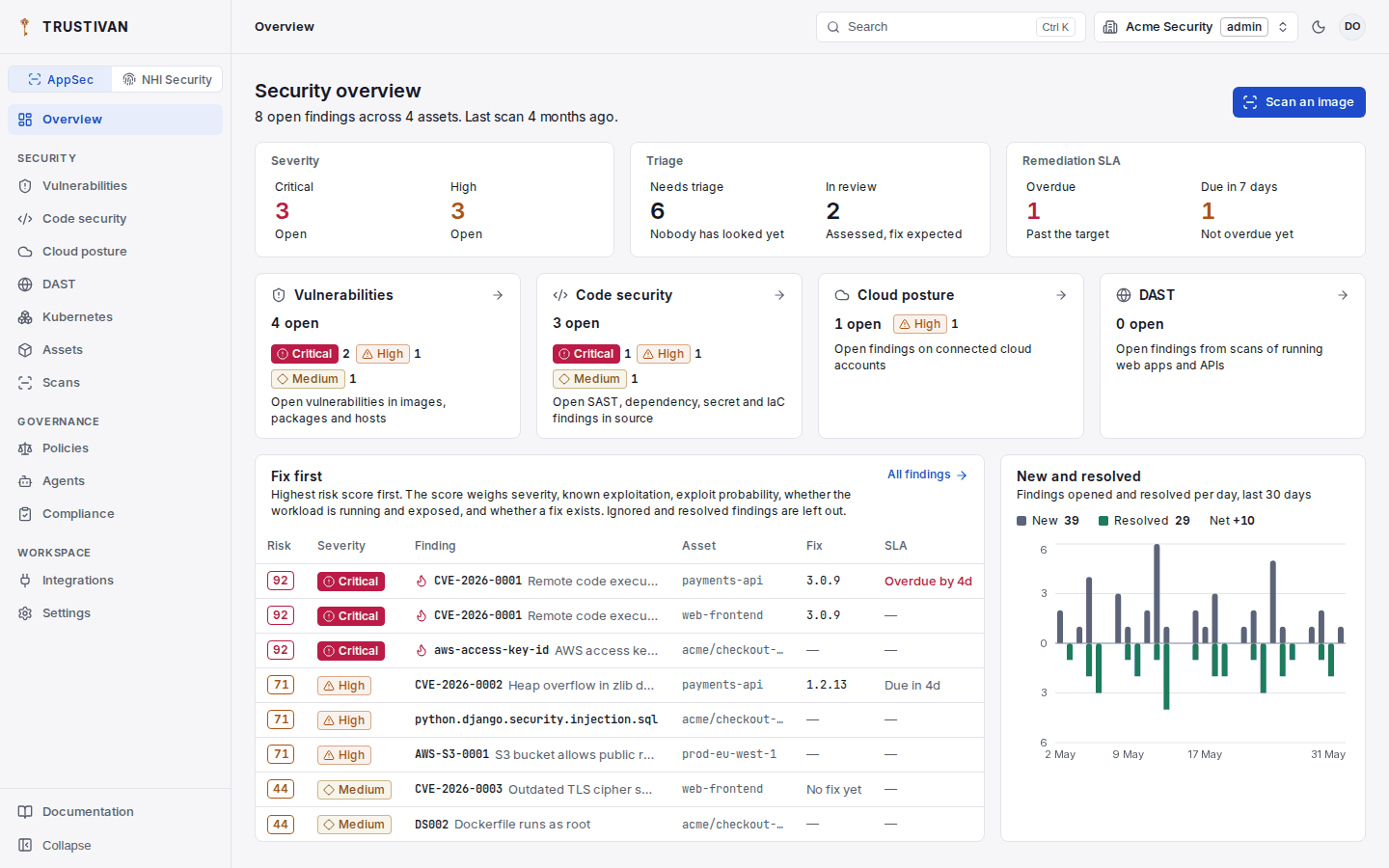
The AppSec console overview. Names and findings are synthetic demonstration data.

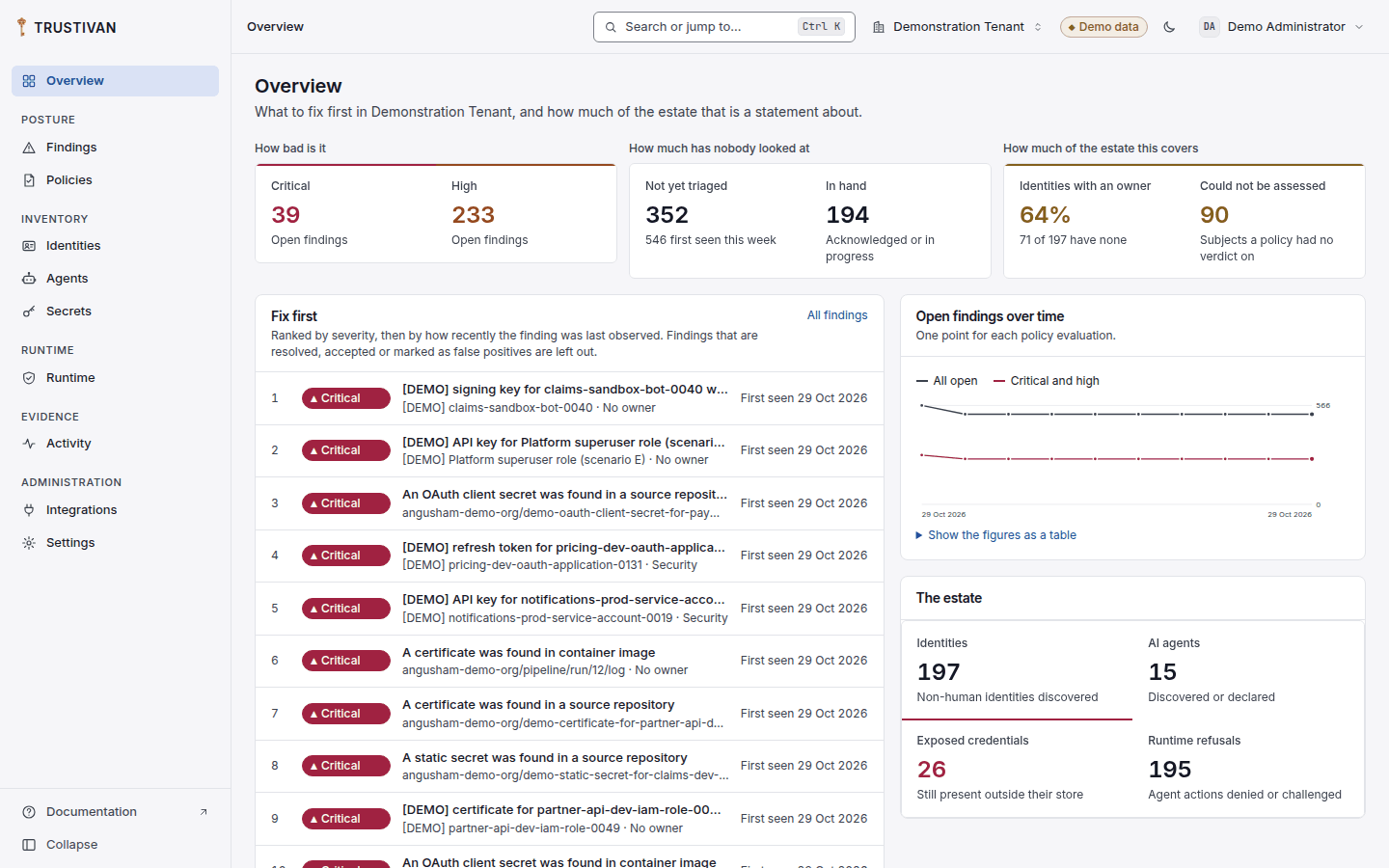
The NHI Security overview. The tenant and identities are synthetic demonstration data.
Where TRUSTIVAN runs
Running it yourself? The Self-hosting tab covers installation,
configuration and operations.
Security and trust
Security model
Credentials, tenant isolation and the data a scan produces.
Agent security contract
What each collector, the sensor, the CLI and the MCP server read, and never do.
Report a vulnerability
How to reach us, and the safe harbour for good-faith research.